UH’s Wellner on Team Detailing Climate Record and Demise of Vegetation as Glaciers Formed
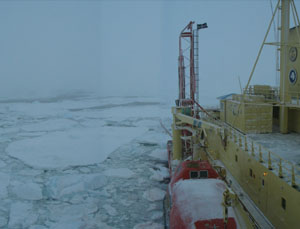
Drill rig mounted on the NSF research vessel Nathaniel B. Palmer in sea ice. (Photo courtesy of Julia Wellner.)
Fossilized pollen found in glacial core samples played a role in a study reconstructing the climatic history of the Antarctic Peninsula and provided a glimpse into the rate at which plants disappeared as the ice spread over the last 35 million years.
The findings appear online in the Proceedings of the National Academy of Sciences and are featured on the July 12 cover of the print edition.
The Antarctic Peninsula, the northernmost part of Antarctica, was the last area to be covered by ice. Drilling techniques similar to those found in the oil industry were used to examine the history of the initial growth of the ice sheet across the Antarctic Peninsula.
“The only way to understand how the Antarctic ice sheets might behave in the future is to understand how they have grown and retreated in the past,” said Julia Wellner, research assistant professor in the UH Department of Earth and Atmospheric Sciences and one of the paper’s authors. Wellner participated in the research project while a postdoctoral fellow at Rice University and completed data analysis after joining the UH faculty.
The National Science Foundation (NSF)-funded project, called SHALDRIL, brought together collaborators from many universities. Led by marine geologist John Anderson of Rice University, the team also included Sophie Warny, a Louisiana State University geologist with a specialty in palynology, the study of fossilized pollen and spores, and a micropaleontologist from University of Southampton, Steven Bohaty, who looked at the fossil record in the cores to determine the age of each zone. More than a dozen researchers were involved in the data collection and analysis efforts.
SHALDRIL was funded in 2002, the same year Wellner began her postdoctoral fellowship. Her initial responsibilities with the project were to manage the planning and logistics of the cruises in the Antarctic aboard the NSF research vessel Nathaniel B. Palmer.
“No one had ever drilled from an icebreaker in the Antarctic, so we had to start from scratch – hiring a drilling company who could work in those conditions, making sure their equipment would fit on the vessel,” she said.
Wellner also learned about the specifics of drilling into glacial sediments, which are known for their mixed grain sizes. “Glacial sediments are quite mixed having some sand grains, pebbles, cobbles, boulders and mud,” she said. “The mixed materials and sizes make it difficult to drill.” The project gathered seven drill cores during two Antarctic cruises in 2005 and 2006.
Joining UH in 2006, Wellner, a marine geologist, began analysis of the sediment in the core samples. “My job was to interpret where the sediments were originally deposited. We wanted to determine whether the sediments were deposited in open ocean, in an ocean close to land, in an ocean that had icebergs or whether it was sediment from beneath ice,” she said.
X-rays of the core samples were taken to view the core’s interior, the characteristics of the sediment and its mineralogy. “We looked at what minerals were in the sediment, the sizes of each particle and the pebble content,” Wellner said. “One of the first things we looked for as a signal of glacial onset was where in the core did we find pebbles.”
UH biology undergraduate Reham Rafe Al Hussien worked with Wellner on the laborious task of examining the x-rays and counting the pebbles that led to the interpretation of when the ice sheet started to grow. “I don’t think Reham initially understood the value of the work she was doing with the x-rays, but, in the end, her counts turned out to be a valuable line of evidence about when icebergs started dropping sediment in the area,” Wellner said.
Once the counting was complete, Wellner fit the information together – number and size of pebbles, mineralogy, clay content – to interpret the first signs of glaciation. The sedimentation data provided by Wellner’s lab helped the team studying the pollen fossils by pinpointing the timing of the ice approach, then the glacial conditions and finally the complete coverage.
“We actually found that there were signs of distal glaciation early on, even when the pollen record still showed relatively diverse flora on the peninsula,” Wellner said. “As the glacial conditions increased, the group studying the pollen record found that the flora became more and more stressed and less and less diverse.”
Wellner has been involved in Antarctic research since 1998 and has been on eight research cruises. Her next research project in the Antarctic is scheduled for March 2012. With funding from NSF, Wellner will study the Larsen ice shelf as part of the LARISSA project.
“That project is a short timescale, looking at samples covering only 10,000 years, so there is no drilling involved. We use gravity cores where the coring apparatus drops on a wire into the sediment. Samples are about 20 meters long,” she said.
The objective of LARISSA is to study the breakup of the Larsen ice shelf to help determine how the climate in the Antarctic Peninsula has changed over time and whether the modern warm condition is unique when compared to the last 10,000 years.
“The Antarctic Peninsula is warming at a rate that is six times faster than the global average. There is still ice there, and as it melts, it isn’t enough to dramatically raise global sea level,” Wellner said. “However, studies on the peninsula of what happens as the ice warms serve as an analog for scientists to determine how the big ice sheets covering up the rest of the continent would behave under warmer conditions.”
###
More information about SHALDRIL and the PNAS article appears in the Rice University and Louisiana State University news release.
- Kathy Major, College of Natural Sciences and Mathematics